
 10 AM – 5 PM

FERTILE RESISTANCE: KADIST Collection-in-Residence
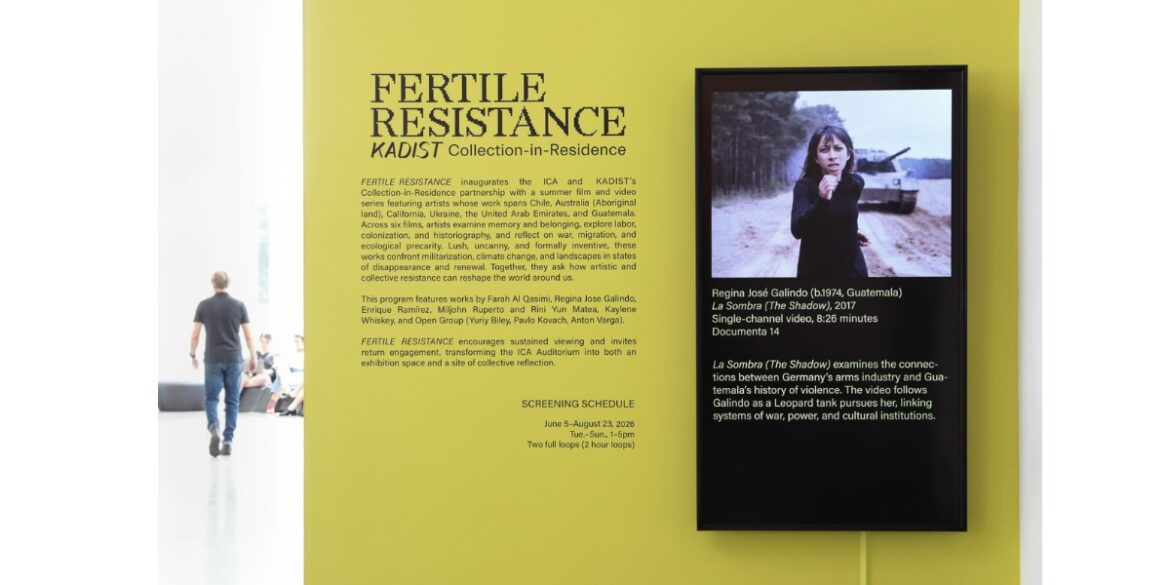
FERTILE RESISTANCE: KADIST Collection-in-Residence, installation view, ICA at VCU, 2026. (photograph by David Hale)
FERTILE RESISTANCE: KADIST Collection-in-Residence, installation view, ICA at VCU, 2026. (photograph by David Hale)
Farah Al Qasimi, Um al-Dhaba (Mother of Fog), 2022, two-channel video installation, color, sound, 29:45 minutes (video still). Courtesy the artist, KADIST collection
Farah Al Qasimi, Um al-Dhaba (Mother of Fog), 2022, two-channel video installation, color, sound, 29:45 minutes (video still). Courtesy the artist, KADIST collection.
Open Group (Yuriy Biley, Pavlo Kovach, Anton Varga), Repeat After Me, 2022, single-channel HD video, karaoke, color, 16:9, sound, 17:00 minutes (video still). Courtesy the artist, KADIST collection.
Open Group (Yuriy Biley, Pavlo Kovach, Anton Varga), Repeat After Me, 2022, single-channel HD video, karaoke, color, 16:9, sound, 17:00 minutes (video still). Courtesy the artist, KADIST collection.
Regina José Galindo, La Sombra (The Shadow), 2017, single-channel FHD video, 16:9, color, sound, 08:26 minutes (video still). Courtesy the artist, KADIST collection.
Miljohn Ruperto, and Rini Yun Matea, Ordinal (SW/NE), 2017, single-channel digital video, color, sound, 43:05 minutes (video still). Courtesy of the artist, licensed by KADIST for its programs.
Miljohn Ruperto, and Rini Yun Matea, Ordinal (SW/NE), 2017, single-channel digital video, color, sound, 43:05 minutes (video still). Courtesy of the artist, licensed by KADIST for its programs.
FERTILE RESISTANCE: KADIST Collection-in-Residence
Friday, Jun 5 – Aug 23
FERTILE RESISTANCE: KADIST Collection-in-Residence is a summer-long program of film and video screenings launching a three-year collection-in-residence collaboration between the ICA and KADIST, the pioneering Paris-based contemporary art organization. Founded on the belief that artists make an essential contribution to a progressive society, KADIST supports work that engages urgently with the present day.
Drawn from KADIST’s collection, the six films gathered here travel across Chile, Whiskey’s Country (Aboriginal land), California, Asia’s modern-day trade hubs, Ukraine, and Guatemala. Together they span poetic and playful meditations on memory, belonging, and resistance; uncanny and critical explorations of labor politics, western historiography, and colonization; and searching studies of the social, sonic, and ecological impacts of war. Lush, immersive, and formally profound, many of these works have been presented at major international events including the Sharjah and Havana Biennials, the Venice Biennale, and past Documentas. They explore societies shaped by militarization, climate change, and ecological precarity — vanishing and reemerging landscapes, and the enduring power of artistic and civil resistance to remake the world.
FERTILE RESISTANCE: KADIST Collection-in-Residence is designed to encourage sustained viewing and return engagement, positioning the ICA Auditorium as both an exhibition space and a site of collective reflection.
La Memoria Verde by Enrique Ramirez
Enrique Ramirez’s La Memoria Verde is a work of poetry, politics, and memory created in response to the curatorial statement for the 13th Havana Biennial in 2019, The Construction of the Possible. Other well known works by Ramirez feature the movement and endless symbolism of the sea—like the simultaneous engagement and retreat of the tide—but La Memoria Verde takes the land, plant life, and its human inhabitants as its subject. The film begins with a soft, green, algae-like image that waxes and wanes in focus, then gives way to swaying treetops blowing in a soft wind. The calls of jungle insects and other fauna blend with intermittent notes played by a man on a saxophone, and the landscape on the ground, invoke lush, fertile, deep greens as if to color even the brass-made timbre. A woman describes, in a soft but deliberate whisper, a series of declarations that cite the plight of the land and the immigrant, the task of memory and of identity, of resistance and survival. La Memoria Verde calls upon the vibrant but dreamlike imagery of unstable memories, drawing the viewer into a hazy world encompassed by low light and dark hue. The work explores a verdant world through sight and sound, navigating the surviving variations of life, both human and rooted. Using lushness and overgrowth as a gesture of assertion and resistance, Ramirez connects the constant conflict and fluctuation of survival that both nature and man have in common. The film tells of imprinted traumas and the ways in which they become visible as scars, or manifest in movements that either protect or enhance their memory. In La Memoria Verde these gestures consume both flora and fauna.
Enrique Ramirez’s highly politicized practice engages both personal recollections and gathered stories, questions notions of exile, displacement, loss of memory, and a changing sense of place. Growing up in Santiago, Chile, his father was a sail-maker and Ramirez’s process often returns to the sea to bolster his investigations of movement, discovery, and geo-politics. The artist describes art and filmmaking as methods to communicate the ways society moves in cycles, sometimes backward and sometimes forward, especially regarding issues of immigration, border politics, and national identity. His seductive films and installations are sites of contemplation and imagination in their depiction of boundless space and expansive landscapes.
Um al-Dhaba (Mother of Fog) by Farah Al Qasimi
Um Al Dhabaab (Mother of Fog) by Farah Al Qasimi addresses the myth of Al Qasimi tribe-instigated piracy in the Gulf, perpetuated by the British Empire and upheld by contemporary western academia. This narrative is contested through a fictional retelling of the 1819 siege of Al Dhayah fort and the subsequent Pax Britannica treaty that solidified Britain’s military presence in the Trucial States. Relayed across various locations and times in Ras Al Khaimah through the perspectives of an ancient jinn, the ghost of an Al Qasimi pirate, two RAK-based sisters, a Jack Sparrow impersonator and ship captain, and an 1819 British naval officer, the film challenges Western-centric historiographies of the Gulf and the lingering imperialist interests at play across Asia’s modern-day trade hubs. The film also grounds this conflict of portrayal in the twenty-first century by drawing parallels to pirate video games and movies in contemporary culture.
The film was co-produced by Sharjah Art Foundation and KADIST, and premiered at the Sharjah Biennial 15: Thinking Historically in the Present opening in February 2023.
Working primarily with photography, video and performance, Farah Al Qasimi examines postcolonial structures of power, gender, and taste in the Gulf Arab states. Dividing her time between Dubai and New York, Al Qasimi has integrated her practice as a social critique and observation of the layered aspects of each place indirectly. Through her bold and vibrant photographs, she explores the unspoken social norms and values embedded in a place, a moment, or an object. Creating work that confront commonplace notions of figurative photography and portraiture, Al Qasimi’s works challenge the viewer to consider their own understanding of reality, aspiration, individuality, and the reflected image.
Regina José Galindo, La Sombra (The Shadow), 2017
La Sombra (The Shadow) is a video of Regina Jose Galindo performing with a moving Leopard tank. The artist runs until exhaustion across a dirt field in what looks like a military site. Recorded for the camera, and projected on loop, the video performance was created for Documenta 14. Galindo dedicated the work to all women who go unnoticed and whose screams remain unheard. The artist states that she wanted to highlight the under-recognized fact that Germany is a major arms exporter, with Guatemala a prize client. The work thus seeks to unpack the city of Kassel’s loaded yet veiled history as one of Germany’s biggest arsenals. The battle-tank that pursues the artist in the video was made for cross-country warfare and invented in Germany. The company who manufactured the turret of the tank is in fact still partially owned by the family of Arnold Bode who founded the Documenta exhibition in 1955. La Sombra points to the entanglement of the apparatuses of art and war and the international art market.
———————————————
From the artist:
We can not escape the horror
Follows us
It is our shadow.
The great powers control the arms market, produce them, sell them. Countries in crisis buy them, use them. Germany is among the top five arms manufacturers in the world. Big profits are made by the sales of Leopard tank, that is exported, inclusive, to conflict areas. It seems that we can not control the battles.
Commissioned and produced by documenta14, Kassel, Germany
Camera and edition Nicolas Rösener
Second camera Gabriel Caballeros
Curator Monika Szewczyk
Production Leon Hösl
Regina José Galindo is a visual and performance artist. Her work investigates the universal ethical implications of social injustices such as racial, gender, and other abuses in our society’s inequitable institutions of power. In the context of a newly democratized culture, Galindo has developed a socially and politically motivated practice. She strives to acknowledge her country’s thirty-six years of civil war while also looking forward to a more peaceful and productive future. Galindo’s work focuses on historical issues that persist in the “new” Guatemala. Her work is confrontational and often shocking, bringing to light issues that few Guatemalans are willing to confront. Galindo’s unapologetically graphic actions amplify her contentious statements. She hopes to shake her Guatemalan audience out of their trance, breaking the numbness caused by years of violence. Galindo is best known for her performance work addressing the social, political and cultural violence that has affected her native Guatemala. Her work stages her own body, often submitting it to severe acts in order to evince the mass violence, crimes and sacrifice experienced by indigenous Mayan communities and the women among them who suffered the brunt of the conflict during the thirty-six year conflict. Indifference is not an option for Galindo, by appropriating destruction and loss, her work condemns the abuse of women, and propels viewers to response or resistance.
Ngura Pukulpa (Happy Place) by Kaylene Whiskey
The short video Ngura Pukulpa – Happy Place offers an extensive view of Whiskey’s Country (Aboriginal land), which reigns through ancestral connections as well as camp fabulousness. The work is experienced as a music video clip where the artist’s voice repeatedly shouts out: “My name is Kaylene! Imantura Whiskey!” (Imantura is the artist’s name in Yankunytjatjara). The first scene is a bird-eye-view of the Whiskey’s arid Country, followed by the artist’s entrance fashioning a glittery dress and hot pink wig as she flies above the vast expanses. At times accompanied by figures born out of her brush and canvas, Kaylene appears dancing with her party crew, erupting in joyous pageantry and celebration, and crossing between the borders of country and fantasy. The seven women reference the seven sisters’ story, one of the main ancestral folk songs/creation stories. In this version, the seven sisters traverse the desert on a Land Cruiser (which could be read as a symbol of settler colonialism) in what appears to be referencing the Australian cult film The Adventures Of Priscilla Queen Of The Desert (1994). Here, animals, spirits, stars, and pop stars all celebrate Whiskey, pointing to the complex landscapes of contemporary First Nations narratives. They hail her as an icon, a diva, and a model of strength and power for women of many worlds who weren’t always the centre and the voice of the story. Fun is thus elevated as the highest form of political affirmation of presence and vibrancy by the artist and her community.
Kaylene Whiskey’s appropriation of Western pop culture, American mainstream television, manifests itself in a unique empowering visual language; a fantasy world where a black wonder woman befriends Dolly Parton. Her iconography merges comic style figuration alongside the ‘dot’ iconography of Australia’s Central Desert, stemming from her Anangu culture. Her paintings celebrate happiness and joy as forms of resilience, and indirectly challenge the cultural essentialisms projected upon Aboriginal art. Her unapologetic liberty and life philosophy debunks the paternalistic establishment of ‘White Australia’ institutionality, as it devours its culture. The scripts of Whiskey’s videos are produced closely through her vision and direction, and they almost always include her own voice and narrative as voice over or singing. Her position in contemporary First Nations art has radically transgressed the art field, turning her art and story part of the public sphere’s conscience on Aboriginal representation, becoming perhaps the most iconic living female artist in Australia today, having national and international exhibitions.
Miljohn Ruperto and Rini Yun Matea Ordinal (SW/NE)
Miljohn Ruperto’s research-based multidisciplinary practice often deals with possession, re-enactment, mythology and archives. These conceptual throughlines also underpin Ruperto and Minneapolis-based artist Rini Yun Matea’s eerie experimental documentary Ordinal (SW/NE), which collapses mythology, scientific research, Californian agricultural history, American literature, and speculative fiction into a poetic and timely examination of possession, infection, and individual agency in an age of wanton industrial agriculture and alienation.
Ordinal (SW/NE) tells the tale of a young Black man named Josiah as he navigates the banalities of daily life while potentially being possessed by a malignant supernatural force or stricken by valley fever, a little-known yet gruesome and sometimes lethal real-life respiratory illness which disproportionately affects farm and field workers, particularly Filipinos and African-Americans. Scenes from Josiah’s movements through institutional and domestic spaces are interwoven with drone footage of vast golden fields, archival photography of California dust storms so enormous that they appear biblical, and black-and-white footage of a scene from John Steinbeck’s canonical novel The Grapes of Wrath, which follows the desolate journey of impoverished American migrants during the Great Depression. Ordinal (SW/NE) is a prismatic work, an expansive Pandora’s Box of storylines moving between the past, present, and mythological time. Yet it remains grounded in regional specificity, as it traces the spiritual effects and cultural-environmental influences of valley fever and the pathogenic fungus coccidioides immitis that causes it. While endemic to the Southwestern United States, valley fever is particularly common in the Central Valley of California, which is the agricultural engine of California as well as a repository for much of the state’s air pollution. The region represents both the insistence of desert irrigation as well as the threat of man-made drought and respiratory sickness, both the miracle of technology and the revenge of the gods.
Miljohn Ruperto is a cross-disciplinary artist working across photography, cinema, performance, and digital animation. His work refers to historical and anecdotal occurrences, and speculates on the nature of assumed facts and the construction of truth. Often involving replicas, modified versions, and enactments—including Chinese-made reproductions of Caspar David Friedrich’s The Monk by the Sea; modified images based on the 15th century Voynich Manuscript; or reworked footage of Filipino actress Isabel Rosario Cooper—Ruperto takes cultural and historical references and untethers them from their original context to challenge our perception and generate something altogether new. Ruperto’s work is often informed by his collaborations with experts from other disciplines including Dutch animator Aimée de Jongh, neuroscientist and engineer Rajan Bhattacharyya, photographer Ulrik Heltoft among others. Through a richness and diversity of lenses, and preferencing the obscure, mysterious and the magical, his work challenges fixed conceptions of truth and history, and instead speaks of an indeterminacy and subjectivity of experience that renders truth and fiction near indistinguishable.
Open Group (Yuriy Biley, Pavlo Kovach, Anton Varga) Repeat After Me
Repeat After Me by Open Group includes installation, video, and karaoke components, which together comprise a manual of sorts for identifying the sounds of enemy weapons used in war. Several weeks before Russia’s full-scale invasion, the Ukraine’s State Emergency Service distributed a manual for citizens that details how to react in areas where military actions occur. The order and type of response depend on whether the attack is conducted via assault rifle fire, artillery shelling, multiple rocket launcher shelling, or even aerial bombardment. Very often, the only way to distinguish the type of fire is to determine the type of weapon by sound. The video’s participants are displaced Ukrainian civilians temporarily residing in a refugee camp in Lviv, who share their memories and expertise in the sounds of war. By reproducing the sounds of various types of weapons, they conduct a kind of instructional karaoke. The transmission of these simple sound sequences, while unable to convey their lived experiences, indicate the price of this knowledge. A knowledge which is the new reality for the Ukrainian citizens–possessing it helps them to survive. Viewers can then repeat these sounds into a microphone placed in front of the video, illuminated by a red spotlight. This microphone plays the role of a portal, acquainting the viewer with the physical experiences of the video participants, and at the same time, a barrier that denotes a certain theatricality and the impossibility of grasping a lived experience of war.
Open Group was founded in 2012 in Lviv by six Ukrainian artists. The group’s structure has changed over the years, and its present members are: Yuriy Biley, Pavlo Kovach, and Anton Varga. They occasionally invite other artists or others to take part in their projects and join the Open Group, thus exploring the concept of collective work, interaction, and communication between people, artists, situations, and spaces. Since 2011, the group members have been running independent art spaces, such as the Detenpyla Gallery and the Efremova26 Gallery in Lviv, Ukraine.